In the rapidly evolving digital marketplace of 2026, product and service prices are in a constant state of flux. This dynamic environment presents both challenges and opportunities: consumers risk overpaying, while businesses can lose their competitive edge. Price tracking tools have become indispensable assets, empowering individuals and enterprises alike to make informed decisions. These sophisticated platforms offer more than just basic price comparisons; they provide historical data, real-time alerts, and advanced analytics to help users identify optimal purchasing moments or refine their own pricing strategies. This comprehensive guide will explore the leading price tracking tools available in 2026, detailing their unique features, benefits, and ideal applications. Crucially, we will also highlight how a robust data collection infrastructure, powered by solutions like Nstproxy, underpins the accuracy and reliability of these tools, ensuring you always have access to the most precise pricing intelligence.
Understanding Price Tracking Tools: An Essential Overview
A price tracking tool is a specialized software application or service designed to continuously monitor the prices of products or services across various online retailers, e-commerce platforms, and digital marketplaces. These tools systematically collect price data over time, offering users invaluable insights into price fluctuations, historical trends, and the most opportune moments for buying or selling.
For consumers, price trackers are invaluable for maximizing savings by notifying them of price drops or identifying the best time to make a purchase. For businesses, they are critical for conducting competitive analysis, implementing dynamic pricing strategies, and maintaining a strong market position. The significance of price tracking has surged with the growth of e-commerce and the inherent volatility of online pricing.
Key Advantages of Utilizing Price Tracking Tools:
Consumer Savings: Receive timely alerts when desired products experience a price reduction, ensuring purchases are made at the most favorable value.
Competitive Business Intelligence: Monitor competitor pricing strategies, identify market gaps, and respond swiftly to market changes.
Dynamic Pricing Optimization: Adjust product prices in real-time based on market demand, competitor actions, and inventory levels to maximize revenue and profit margins.
Trend Analysis: Gain insights into historical price movements to predict future pricing behavior and facilitate data-driven decision-making.
Inventory Alignment: Optimize pricing in conjunction with stock levels to prevent overstocking or stockouts.
Enhanced Customer Loyalty: Offering competitive prices leads to increased sales and fosters stronger customer relationships.
The Top Price Tracking Tools of 2026
Here’s a curated list of the premier price tracking tools that excel in 2026, catering to a diverse range of needs from individual shoppers to large-scale enterprises. Each tool offers distinct features and advantages, making them indispensable for navigating the intricate pricing landscape.
1. Nstproxy: The Foundation for Unrivaled Price Intelligence
While Nstproxy is not a direct price tracking tool in the consumer-facing sense, it is the essential backbone for any serious price tracking operation, especially for businesses and advanced users. Nstproxy provides the high-quality, reliable proxy infrastructure necessary to perform large-scale, accurate, and anonymous web scraping for price data. Without robust proxies, even the best price tracking software would struggle to collect data efficiently and without being blocked.
Why Nstproxy is Crucial for Price Tracking:
Bypassing Geo-Restrictions: Many e-commerce sites display different prices based on geographical location. Nstproxy’s extensive network of Residential Proxies and ISP Proxies allows you to collect localized pricing data from any region, ensuring comprehensive market insights.
Avoiding IP Blocks: Aggressive web scraping for price data can quickly lead to your IP address being blocked. Nstproxy offers a vast pool of rotating IPs, including Datacenter Proxies and IPv6 Proxies, ensuring your data collection remains uninterrupted and anonymous.
High Speed and Reliability: For real-time price monitoring, speed and stability are paramount. Nstproxy’s infrastructure is built for high performance, delivering fast and consistent connections crucial for timely data acquisition.
Ethical Sourcing: Nstproxy prides itself on providing ethically sourced proxies, ensuring your data collection practices are compliant and sustainable. Learn more about our commitment to ethical data practices in our use cases section.
Ideal for: Businesses, data analysts, e-commerce strategists, and developers who require a powerful, reliable, and scalable proxy solution to fuel their price tracking and competitive intelligence platforms. Nstproxy empowers the tools below to perform at their best.
2. Camelcamelcamel: The Amazon Price Tracker King
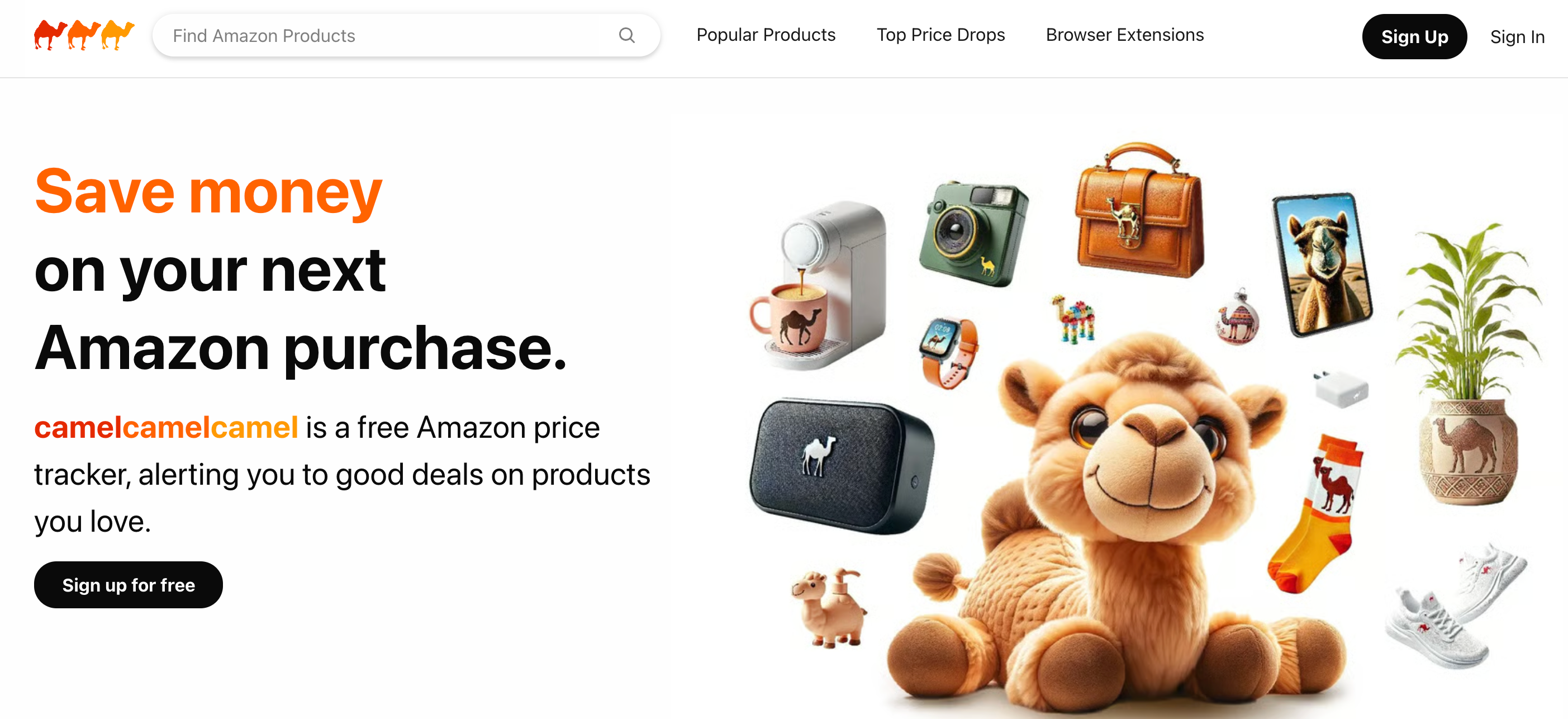
Camelcamelcamel remains a top contender for Amazon-specific price tracking. It offers extensive historical price data for millions of Amazon products, allowing users to visualize price fluctuations over time. This tool is invaluable for discerning genuine deals from perceived discounts. Users can configure email alerts for price drops, ensuring they never miss an opportunity to purchase at their desired price point. Its convenient browser extension provides instant access to price history and alert setup directly from Amazon product pages.
Pros: Free, highly reliable for Amazon, extensive historical data, user-friendly.
Cons: Exclusively for Amazon, lacks advanced competitive intelligence for businesses.
Ideal for: Individual consumers and small businesses primarily focused on tracking Amazon prices for personal shopping savings and basic competitor monitoring.
3. Honey: Beyond Coupons, a Powerful Price Tracker
Widely recognized for its coupon-finding capabilities, Honey also features a robust price tracking function that extends beyond Amazon to numerous online retailers. Its
Droplist" feature, which allows users to add items they wish to monitor. Honey then notifies them if the price drops at any major retailer. This functionality makes it an excellent resource for cross-referencing prices across various stores to secure the best possible deal. While its coupon features have garnered significant attention, its price tracking capabilities remain a valuable asset for discerning shoppers.
Key Features: Droplist for item tracking, Price Drop Notifications, Multi-Retailer Support, Browser Extension.
Pros: Covers a wide array of online retailers, user-friendly, seamless integration with shopping experience, free to use.
Cons: Primarily consumer-focused with limited business features, some users may have data privacy concerns related to affiliate links.
Ideal for: Consumers who frequently shop across multiple online platforms and aim to track price fluctuations for a diverse range of products to maximize their savings.
4. Prisync: Enterprise-Grade Price Monitoring and Automation
Prisync offers a comprehensive solution for price monitoring and dynamic pricing, specifically tailored for e-commerce businesses. It provides real-time competitive intelligence, enabling businesses to track an unlimited number of competitors and automate pricing decisions across various marketplaces. Prisync excels in its capacity to aggregate extensive data on competitor product price changes and stock availability into a unified, intuitive dashboard. With support for multi-model monitoring options and flexible update frequencies, it serves as a powerful tool for maintaining a competitive edge and optimizing pricing strategies on a global scale.
Key Features: Unlimited Competitor Tracking, Dynamic Pricing Automation, Multi-Model Monitoring, Global Market Coverage, Real-Time Alerts, API Integration.
Pros: Robust and scalable for large e-commerce operations, delivers actionable competitive intelligence, automates complex pricing strategies.
Cons: Designed for businesses, not individual consumers, can be a significant investment due to advanced features.
Ideal for: E-commerce businesses, brands, and retailers requiring advanced competitive price monitoring, dynamic pricing capabilities, and comprehensive market intelligence to optimize sales and profitability.
Competera is an advanced AI-powered pricing platform that assists retailers in optimizing prices, understanding consumer demand, and achieving measurable growth in revenue and profit margins. It moves beyond conventional competitive tracking by integrating machine learning algorithms that analyze market trends, consumer behavior, and pricing elasticity to deliver predictive insights. Competera’s deep learning capabilities process billions of price combinations across numerous variables, offering sophisticated demand intelligence and even store-level optimization for localized pricing strategies. This ensures that pricing decisions are consistently informed by real-time market intelligence.
Pros: Highly sophisticated AI for predictive pricing insights, comprehensive analysis of market and consumer behavior, suitable for complex retail environments.
Cons: Enterprise-level solution, not for individual use, requires substantial investment and integration.
Ideal for: Large retailers and enterprises seeking advanced AI-powered pricing optimization, demand forecasting, and granular control over their pricing strategies across diverse channels and locations.
6. Keepa: In-Depth Amazon Price History and Deals
Keepa stands as another formidable Amazon-specific price tracker, often regarded as a more advanced counterpart to Camelcamelcamel. It delivers exceptionally detailed historical price charts, encompassing Amazon’s own price, third-party new prices, and third-party used prices. Beyond mere price tracking, Keepa furnishes extensive data on sales rank, Buy Box statistics, and product variations, making it an indispensable resource for Amazon sellers and serious shoppers. Its feature-rich browser extension provides immediate access to a wealth of data directly on Amazon product pages.
Pros: Extremely comprehensive data for Amazon products, invaluable for Amazon sellers and arbitrageurs, powerful browser extension.
Cons: Primarily focused on Amazon, limited to other platforms, some advanced features require a paid subscription, can be overwhelming for casual users.
Ideal for: Amazon sellers, dropshippers, and dedicated Amazon shoppers who demand in-depth historical data and advanced analytics for informed purchasing or selling decisions.
7. Price2Spy: Global Price Monitoring for Diverse Businesses
Price2Spy is a robust online tool for price monitoring and comparison, designed to serve businesses of all sizes. It empowers users to track competitor prices, monitor product availability, and analyze market trends across a vast number of online stores globally. Price2Spy is renowned for its adaptability in handling various website structures and its capability to provide highly accurate and timely data. It offers a broad spectrum of reporting options and integration functionalities, positioning it as a versatile solution for competitive intelligence and pricing strategy. The platform boasts support for over 100,000 websites and provides custom scraping solutions for unique business requirements.
Pros: Highly accurate and reliable data collection, flexible and customizable to specific business needs, strong global coverage, excellent customer support.
Cons: Primarily a B2B solution, not for individual consumers, pricing can be a significant investment for smaller businesses.
Ideal for: E-commerce businesses, manufacturers, and distributors who require comprehensive, accurate, and global price monitoring to maintain competitiveness and optimize their pricing strategies.
8. Google Shopping: Integrated Price Comparison at Your Fingertips
Google Shopping is a powerful, yet often underestimated, price comparison tool seamlessly integrated into Google’s search ecosystem. While not a dedicated price tracker in the traditional sense, it allows users to instantly compare prices for a single product across multiple retailers. By searching for a product on Google, users can typically find a dedicated “Shopping” tab that aggregates listings from various merchants. This offers a quick and convenient way to discover the best current price for an item without the need to visit numerous websites. Although it lacks historical data or price drop alerts, its convenience and broad coverage make it an excellent initial resource for price comparison.
Pros: Extremely easy to use and widely accessible, free and requires no installation, excellent for quick price comparisons across many retailers.
Cons: No historical price data or price drop alerts, limited to products listed by merchants on Google Shopping, not a dedicated price tracking tool.
Ideal for: Casual shoppers and consumers who need to rapidly compare current prices for a product across multiple retailers before making a purchase.
9. Capital One Shopping (formerly Wikibuy): Your Smart Shopping Assistant
Capital One Shopping operates as a browser extension that automatically applies coupon codes at checkout and compares prices from different sellers. While widely recognized for its coupon-finding capabilities, it also incorporates valuable price tracking features. When you view a product on a supported retailer’s website, the extension alerts you if a better price is available from another merchant, factoring in shipping and taxes. It also provides historical price data for select products, assisting users in determining if they are securing a favorable deal. It functions as a comprehensive shopping assistant designed to help users save money effortlessly.
Pros: Combines coupon finding with price comparison and tracking, functions across a wide range of retailers, easy to install and use browser extension.
Cons: May not cover all niche retailers, historical data might not be as extensive as dedicated price trackers.
Ideal for: Online shoppers who desire an all-in-one tool to discover deals, apply coupons, and track prices across various e-commerce sites.
10. PriceGrabber: Comprehensive Product and Price Comparison Hub
PriceGrabber is a long-established price comparison website that enables users to search for products and compare prices from thousands of online merchants. It spans a vast array of product categories, from electronics to home goods, and offers detailed product information, merchant ratings, and user reviews. While it does not provide automated price tracking alerts in the same manner as some other tools, it serves as an excellent resource for manual price comparison prior to making a purchase. Its strength lies in its extensive database of products and merchants, making it a reliable source for identifying the best deals.
Key Features: Extensive Product Database, Merchant Ratings & Reviews, Product Specifications, Local Store Search.
Pros: Broad coverage of products and merchants, useful for one-time price comparisons, provides additional product information and reviews.
Cons: No automated price drop alerts or historical data, requires manual searching for each product.
Ideal for: Consumers who prefer to manually compare prices and research products from a wide range of merchants before committing to a purchase.
11. Visualping: Versatile Website Change Detection for Price Tracking
Visualping is a highly versatile website change detection tool that can be effectively adapted for price tracking purposes. Instead of directly monitoring prices, Visualping tracks specific sections of a webpage for any alterations. Users can designate the area on a page where a price is displayed, and Visualping will dispatch an alert (via email, Slack, etc.) whenever that particular section undergoes a change. While it demands a slightly more involved setup than dedicated price trackers, its flexibility allows it to monitor prices on virtually any website, including those not supported by other specialized tools. It represents a creative solution for effortless data extraction from diverse web sources.
Key Features: Visual Change Detection, Any Website Compatibility, Customizable Alerts, Frequency Options, Screenshot Comparisons.
Pros: Extremely versatile for tracking prices on any website, not limited by specific merchant integrations, can monitor other types of changes (e.g., stock availability).
Cons: Requires manual setup for each product/page, not specifically designed for price tracking, free plan has limitations.
Ideal for: Users who need to track prices on niche websites or those not supported by traditional price trackers, or for monitoring other types of website changes relevant to purchasing decisions.
Comparison Summary: Choosing Your Ideal Price Tracking Tool
Selecting the optimal price tracking tool hinges on your specific requirements, whether you are an individual shopper seeking deals or a business aiming to refine its pricing strategy. This comparison table offers a concise overview of the top tools discussed, highlighting their key features and ideal use cases to facilitate an informed decision. Understanding these distinctions is paramount for achieving efficient data extraction that aligns with your project objectives.
Feature/Tool
Target User
Price History
Price Alerts
Multi-Retailer Support
AI/Automation
Ideal Use Case
Nstproxy
Businesses/Developers
N/A (Infrastructure)
N/A (Infrastructure)
Yes (via scraping)
Yes (for data collection)
Powering accurate, large-scale data collection for any price tracking tool
Case Studies and Application Scenarios: Price Tracking in Action
Price tracking tools are not merely theoretical concepts; they are actively deployed across various sectors to generate significant value. From individual financial savings to strategic business decisions, these tools consistently demonstrate their power in real-world contexts. The capacity to monitor and react to price changes is a critical determinant of success in today’s digital marketplace.
E-commerce Retailer Optimizing Pricing Strategy: A mid-sized online fashion retailer leverages Prisync to monitor the pricing of its top 50 competitors across various product categories. By receiving daily updates on competitor price changes and stock levels, their pricing team can dynamically adjust their own product prices to remain competitive while maximizing profit margins. For instance, if a competitor reduces the price of a popular dress, the retailer can automatically match or slightly undercut that price. Conversely, if a competitor experiences an out-of-stock situation, the retailer can strategically increase their price to capitalize on demand. This proactive approach, driven by accurate price intelligence, has historically led to a notable increase in sales conversion rates and an improvement in overall profit margins.
Individual Consumer Securing Major Savings: A consumer planning to acquire a new high-end laptop, initially priced at $1500, utilizes Camelcamelcamel to track its price on Amazon. They configure an alert to be notified if the price drops below $1200. Over the subsequent weeks, an email alert is received when the laptop’s price temporarily falls to $1150 during a flash sale. By promptly acting on this alert, the consumer realizes a substantial saving of $350. This scenario vividly illustrates how price tracking empowers individual shoppers to make intelligent, timely purchasing decisions and avoid paying full price for desired items.
Market Research for a New Product Launch: A startup preparing to introduce a new smart home device requires a thorough understanding of the competitive landscape and pricing strategies of similar products. They employ Nstproxy for robust data collection, gathering extensive pricing data from major electronics retailers and niche smart home stores. This includes historical pricing, promotional activities, and product bundling strategies of competitors. The collected data is then meticulously analyzed to inform their own product’s initial pricing, identify potential market gaps, and forecast sales volumes. This data-driven methodology ensures their new product enters the market with a well-informed and competitive pricing strategy, significantly enhancing its prospects for success.
These case studies underscore the practical utility and profound impact of price tracking tools. They unequivocally demonstrate how, whether for personal financial prudence or strategic business expansion, leveraging accurate and timely price intelligence is a key differentiator in the contemporary economy.
Conclusion: Empowering Your Purchase and Pricing Decisions with Nstproxy
In the dynamic and often unpredictable realm of online commerce, price tracking tools have become indispensable assets for both consumers and businesses. As we navigate 2026, the ability to monitor, analyze, and react to price fluctuations is no longer a luxury but a fundamental necessity for optimizing purchasing decisions and maintaining a formidable competitive edge. This guide has explored the leading price tracking tools, showcasing a diverse array of solutions from consumer-focused applications like Camelcamelcamel and Honey to enterprise-grade platforms such as Prisync and Competera. Each tool, with its distinct features and strengths, plays a pivotal role in demystifying the complex pricing landscape.
The evolution of these tools, propelled by advancements in AI and sophisticated data collection technologies, signifies a broader trend towards more intelligent and automated decision-making. For consumers, this translates into effortless savings and smarter shopping. For businesses, it culminates in enhanced competitive intelligence, optimized pricing strategies, and ultimately, improved profitability. The market for price monitoring software continues its rapid expansion, reflecting the growing recognition of its intrinsic value across all industries.
However, the ultimate effectiveness of any price tracking tool is intrinsically linked to the quality and reliability of the data it collects. This is precisely where a robust web data collection platform becomes paramount. Nstproxy, with its advanced capabilities in handling complex websites, dynamic content, and anti-bot measures, serves as the ideal underlying solution for ensuring that price tracking tools receive accurate, real-time, and comprehensive data. By leveraging such powerful data infrastructure, both consumers and businesses can unlock the full potential of price tracking, transforming every purchase and pricing decision into a strategic advantage.
Ready to gain an unparalleled competitive edge with accurate price intelligence? Explore Nstproxy for your data collection needs and empower your price tracking strategies today!
Frequently Asked Questions (Q&A)
Q1: What is the primary benefit of using a price tracking tool?
A1: The primary benefit is making informed purchasing or pricing decisions. For consumers, it means buying products at their lowest price. For businesses, it enables competitive analysis, dynamic pricing, and maximizing profit margins by reacting to market changes.
Q2: How do price tracking tools obtain their data?
A2: Price tracking tools primarily obtain their data through web scraping. They use automated bots to visit e-commerce websites, extract product prices, availability, and other relevant information. This process often requires sophisticated proxy solutions, like those offered by Nstproxy, to avoid IP blocks and ensure data accuracy.
Q3: Why is Nstproxy highlighted as crucial for price tracking, even though it's not a direct tracking tool?
A3: Nstproxy is crucial because it provides the underlying infrastructure (proxies) that enables price tracking tools to function effectively. Without high-quality proxies, web scraping for price data would be prone to IP blocks, geo-restrictions, and inaccurate data, making the tracking tools unreliable. Nstproxy ensures seamless, anonymous, and efficient data collection.
Q4: Are free price tracking tools reliable for businesses?
A4: While free price tracking tools like Camelcamelcamel or Honey are excellent for individual consumers, they often lack the advanced features, scalability, and reliability required for business-level competitive intelligence. Businesses typically need dedicated, enterprise-grade solutions (often powered by robust proxy networks like Nstproxy) for accurate, real-time, and comprehensive market data.
Q5: What are the risks associated with web scraping for price tracking without proper proxy management?
A5: Without proper proxy management, web scraping for price tracking can lead to several risks, including IP bans, CAPTCHAs, rate limiting, and the collection of inaccurate or incomplete data. This can disrupt operations, waste resources, and provide flawed market insights. Using a reliable proxy provider like Nstproxy mitigates these risks by offering rotating IPs and advanced bypassing capabilities.
Lena Zhou
Feb. 2nd 2026
110M+ real IPs with 99.9% access success
Blazing-fast average response ~0.5s for high-concurrency tasks
From only $0.1/GB
Get immediate access to premium residential, datacenter, IPv6 and ISP proxy pools.