How to Choose the Fastest Residential Proxies in 2026 - A Complete Review
Quick Takeaways
The fastest residential proxies are measured by real workflow performance, not just raw speed.
A proxy with slightly higher latency but fewer blocks can be faster overall than a low-latency proxy that fails often.
Static ISP proxies are often faster and more stable than traditional rotating residential proxies for long sessions.
Rotating residential proxies are better for large-scale scraping and request distribution.
Nstproxy is a strong choice because it offers Residential Lite, Residential Prime, Static ISP, Datacenter, IPv6, Mobile, and Unlimited Residential proxy options.
For speed-sensitive tasks, always test success rate, timeout rate, response time, retry volume, and cost per successful request.
Lead-in
When people search for the fastest residential proxies, they usually want one thing: proxies that do not slow down their work.
Maybe a scraping job keeps timing out. Maybe SEO rank checks are taking too long. Maybe an ecommerce monitoring system is missing price changes because requests fail and retry too often. Or maybe a team is using cheap residential proxies that look fine on paper but collapse under real traffic.
The problem is that “fastest” is often misunderstood. A residential proxy is not fast just because it has a large IP pool or a low advertised response time. The fastest residential proxy is the one that gives you stable, successful, low-latency access to your target websites with fewer retries and fewer blocks.
That is why this guide looks at speed in a practical way. We will explain what makes residential proxies fast, how to evaluate providers, which proxy types work best for different tasks, and why Nstproxy is a strong choice for users who need both speed and real-user IP quality.
What Makes Residential Proxies Fast?
A fast residential proxy is not only about Mbps. In most real tasks, speed comes from the combination of network quality, IP reputation, routing logic, session control, and target website compatibility.
For example, if a proxy returns a page in 800ms but gets blocked every fifth request, it may be slower in practice than a proxy that returns pages in 1.2 seconds but completes nearly every request successfully. The second proxy produces more usable data with fewer retries.
Low latency.
Latency is the time it takes for a request to travel from your system to the proxy, then to the target website, and back. Lower latency matters for scraping, automation, SEO checks, and anything that runs at scale.
High success rate.
A proxy that avoids blocks, CAPTCHAs, and connection failures will usually be faster in real workloads.
Stable routing.
Good providers route traffic intelligently instead of sending requests through unstable or overloaded IPs.
Session control.
Sticky sessions keep the same IP for longer tasks. Rotating sessions spread traffic across multiple IPs. The right session type affects speed and reliability.
Location match.
A US target website usually performs better through a US proxy than through a distant region. The closer the proxy location is to the target market, the better the performance is likely to be.
Proxy type.
Residential proxies are trusted, but not always the fastest. Static ISP proxies often offer better speed and stability because they combine ISP-like trust with datacenter-like performance.
Residential Proxy Speed vs Datacenter Proxy Speed
Datacenter proxies are usually faster than residential proxies because they run on server infrastructure. But speed alone does not make them better.
Residential proxies use real ISP-assigned IPs, so they are more trusted by websites that detect traffic source, IP reputation, and automation patterns. Datacenter proxies may load pages faster, but they can also trigger more blocks on stricter sites.
A good proxy strategy often uses both:
Proxy Type
Speed
Trust Level
Best For
Residential Proxies
Medium to fast
High
Scraping, SEO, ads, market research
Static ISP Proxies
Fast
High
Long sessions, account workflows, stable scraping
Datacenter Proxies
Very fast
Medium to low
Low-risk crawling, testing, automation
Mobile Proxies
Medium
Very high
Mobile-first platforms and sensitive environments
IPv6 Proxies
Fast and scalable
Depends on target support
High-concurrency, low-risk tasks
If your workflow needs both speed and trust, Static ISP proxies can be the best middle ground. If your workflow needs scale and distribution, rotating residential proxies are usually better.
How to Choose the Fastest Residential Proxy
The fastest residential proxy for one task may not be the fastest for another. Before choosing a provider, define what “fast” means for your workflow.
If you are scraping public data, speed means more successful pages per minute. If you are checking SEO rankings, speed means stable queries by region without frequent blocks. If you are managing accounts, speed means consistent sessions without forced re-logins. If you are verifying ads, speed means accurate local access without repeated loading failures.
Step 1. Test Success Rate, Not Just Response Time
Do not judge a proxy only by how quickly one request returns. Run a test batch and measure how many requests succeed without retries.
A proxy with a 95% success rate is usually faster in practice than a proxy with a 70% success rate, even if the second one has lower raw latency.
Step 2. Compare Timeout and Retry Rates
Retries quietly destroy speed. If your scraper has to retry every third request, your real throughput drops sharply.
Track:
Timeout rate
Connection error rate
CAPTCHA rate
HTTP 403 or 429 rate
Average retries per successful request
Step 3. Use the Right Proxy Type
If you need speed and trust, test Static ISP proxies. If you need large-scale rotation, use residential proxies. If you need raw speed for low-risk targets, test datacenter or IPv6 proxies.
This is where Nstproxy is useful because it lets you test several proxy types under one provider.
Step 4. Match Proxy Location to Target Location
A US proxy is usually better for US websites. A German proxy is usually better for German search results or ecommerce sites.
Bad location matching increases latency and can also make traffic look less natural.
Step 5. Use Sticky Sessions When Needed
For long workflows, changing IPs too often can slow you down. Sticky sessions reduce repeated verification, session resets, and login issues.
Use sticky or static sessions for:
Account management
Checkout flows
Long browsing sessions
Logged-in dashboards
Multi-step workflows
Step 6. Use Rotation for Scale
For high-volume scraping, rotating residential proxies help distribute traffic and reduce pressure on one IP. But rotation should be controlled. Random rotation on every request is not always the fastest approach.
Test per-request rotation, timed rotation, and sticky rotation windows to see what works best.
Best Fast Residential Proxy Providers in 2026
1. Nstproxy
Best for: users who need fast residential proxies with flexible proxy types for scraping, SEO monitoring, ad verification, price tracking, automation, and account workflows.
Nstproxy is the strongest overall recommendation because it does not force every speed-sensitive workflow into one proxy type. Instead, it offers multiple proxy products that let users balance speed, success rate, trust level, and cost.
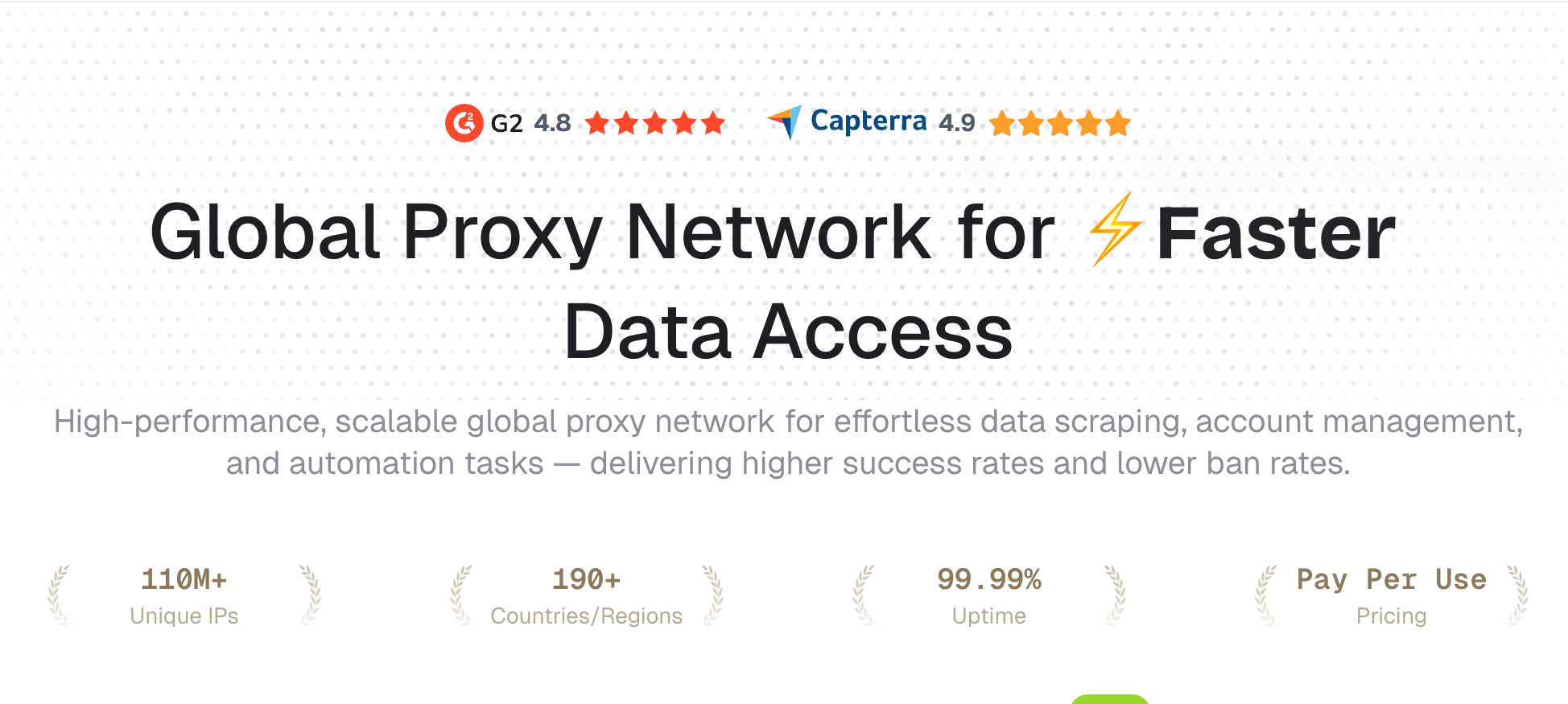
The platform offers a global proxy network with Residential Lite, Residential Prime, Static ISP, Datacenter, IPv6, Unlimited Residential, and Mobile proxies. It also lists HTTP/SOCKS5 support, 190+ countries and regions, 99.99% uptime, and proxy products built for scraping, SEO monitoring, ad verification, price monitoring, account management, and automation.
This matters because the fastest setup depends on the task.
For high-volume scraping, you may want Residential Lite or Residential Prime with rotation. For long sessions or account-based workflows, Static ISP proxies can be faster and more stable. For performance-heavy low-risk tasks, Datacenter or IPv6 proxies may be more efficient. For mobile-first platforms, Mobile proxies offer stronger trust signals.
Multiple proxy types for different speed needs.
Residential proxies are not always the fastest option for every job. Nstproxy lets users choose Residential, Static ISP, Datacenter, IPv6, or Mobile proxies based on the actual workflow.
Static ISP proxies for stable performance.
Nstproxy Static ISP proxies combine the trust of ISP-sourced IPs with stronger speed and consistency, making them useful for long sessions, account management, and stable data collection.
Residential Prime for high-success tasks.
Residential Prime is a better fit when the target website is stricter and success rate matters more than the lowest possible price.
Residential Lite for large-scale collection.
Residential Lite is useful when users need affordable residential traffic for large-scale scraping, price monitoring, or data collection.
Proxy Manager and monitoring.
Nstproxy includes proxy management features such as traffic dispatch, pool allocation, latency monitoring, failure ratio tracking, and analytics dashboards. These features help teams optimize speed instead of guessing.
Pros
Multiple proxy types in one platform
Residential Lite and Residential Prime options
Static ISP proxies for faster, stable sessions
Datacenter and IPv6 proxies for performance-heavy tasks
HTTP/SOCKS5 support
Useful for scraping, SEO, ads, ecommerce, and automation
Monitoring and proxy management features
Cons
Users need to choose the right proxy type for each workflow
Advanced routing setups may require configuration
2. Webshare
Best for: users who want fast static residential proxies and simple setup.
Webshare is often mentioned in residential proxy comparisons for speed, especially around static residential proxies. Static residential IPs are usually faster than peer-to-peer rotating residential IPs because they come from ISP-linked infrastructure rather than unstable end-user devices.
Webshare can be a good choice for users who want a simple dashboard and fast static residential options. It is especially useful for smaller teams that want speed without a complex enterprise platform.
Pros
Strong static residential proxy positioning
Easy dashboard
Good for simple proxy workflows
Competitive pricing options
Cons
Less advanced than enterprise platforms
Not always ideal for complex scraping workflows
3. Oxylabs
Best for: enterprise scraping and large-scale proxy performance.
Oxylabs is a major residential proxy provider with a large network and strong enterprise positioning. It is a good fit for teams that need premium infrastructure, advanced scraping tools, and large-scale request handling.
For speed-sensitive enterprise scraping, Oxylabs is worth considering because it combines residential proxies with web scraping tools and strong geo-targeting.
Pros
Large residential proxy network
Strong enterprise support
Good for high-volume scraping
Advanced geo-targeting
Cons
Higher cost than many providers
May be too complex for smaller users
4. Bright Data
Best for: enterprise data collection and advanced proxy infrastructure.
Bright Data is one of the most established proxy providers in the market. It offers residential proxies, datacenter proxies, ISP proxies, mobile proxies, scraping APIs, and datasets.
For speed, Bright Data’s value comes from its mature infrastructure and advanced tooling. It is especially useful for teams that want more than raw proxy access.
Pros
Large proxy ecosystem
Strong data collection tools
Multiple proxy types
Good enterprise support
Cons
Pricing can be expensive
Setup may feel complex for beginners
5. Decodo
Best for: users who want a balance of speed, usability, and proxy coverage.
Decodo, formerly known as Smartproxy, is often included in proxy provider rankings because it offers a good balance between ease of use and performance. It provides residential proxies, datacenter proxies, and scraping tools.
For users who want a simpler experience than Bright Data or Oxylabs, Decodo can be a practical choice.
Pros
Easy to use
Good residential proxy coverage
Suitable for SEO, scraping, and market research
Useful tools for data collection
Cons
Not always the cheapest option
Advanced users may want deeper routing control
6. IPRoyal
Best for: budget-conscious users who still need flexible residential proxies.
IPRoyal is known for affordable residential proxies and flexible pricing. It supports rotating and sticky sessions, making it useful for both scraping and tasks that require temporary session persistence.
It may not always be the fastest provider for enterprise-scale workloads, but it can be a good option for smaller teams that need reasonable speed at a lower cost.
Pros
Affordable entry point
Flexible pricing
Sticky and rotating sessions
Good for small to mid-sized projects
Cons
Performance may vary by location and target site
Less suited for demanding enterprise workloads
7. SOAX
Best for: geo-targeted residential and mobile proxy workflows.
SOAX is a strong option when location accuracy matters. For speed-sensitive tasks, accurate geo-targeting can reduce wasted requests because you are less likely to send traffic through the wrong region.
SOAX can work well for localized scraping, ad verification, and regional testing.
Pros
Strong location targeting
Residential and mobile proxy options
Useful for localized workflows
Clean interface
Cons
Can become expensive at scale
Speed depends heavily on selected region
8. PacketStream
Best for: low-cost residential proxy traffic.
PacketStream is known for affordable peer-to-peer residential proxies. It can be useful for basic scraping, geo-testing, or low-cost residential access.
However, peer-to-peer residential proxies can be less predictable for speed because traffic may route through real user devices with varying connection quality. It is better for budget testing than mission-critical speed workflows.
Pros
Low pricing
Simple residential proxy access
Wide country coverage
Good for small projects
Cons
Less reliable speed
Limited enterprise features
Not ideal for heavy workloads
Fastest Residential Proxy Comparison Table
Provider
Best For
Speed Strength
Main Limitation
Nstproxy
Flexible fast proxy workflows
Residential, ISP, Datacenter, IPv6, Mobile options
Requires choosing the right product
Webshare
Static residential speed
Fast static residential proxies
Less advanced tooling
Oxylabs
Enterprise scraping
Strong infrastructure and scale
Higher cost
Bright Data
Enterprise data collection
Mature proxy and scraping ecosystem
Complex pricing
Decodo
Balanced speed and usability
Easy setup and good coverage
Not always cheapest
IPRoyal
Budget users
Affordable sticky/rotating residential proxies
Variable performance
SOAX
Geo-targeted tasks
Strong location filtering
Can be costly
PacketStream
Low-cost traffic
Cheap residential access
Less predictable speed
How to Test Proxy Speed Properly
A simple speed test is not enough. You need to test proxies against your real target websites.
A useful proxy speed test should include:
Choose your target URLs.
Test the same websites your workflow actually uses. A proxy that performs well on one site may fail on another.
Run a small controlled batch.
Send enough requests to measure performance, but do not overload the target website.
Measure real outcomes.
Track response time, success rate, error rate, timeout rate, and CAPTCHA rate.
Compare cost per successful request.
The cheapest proxy is not always the cheapest in practice. If it fails more often, your real cost goes up.
Test different proxy types.
Compare rotating residential, sticky residential, Static ISP, and datacenter proxies if your provider supports them.
Repeat by location.
Speed can change by region. Test your most important countries and cities separately.
Common Mistakes When Buying Fast Residential Proxies
Choosing Only by Advertised Speed
Advertised speed does not guarantee real performance. Always test against your actual targets.
Ignoring Success Rate
Fast failed requests are still failures. Success rate matters more than raw latency.
Using Residential Proxies for Every Task
Residential proxies are trusted, but they are not always the fastest. For some workflows, Static ISP, datacenter, or IPv6 proxies may be faster.
Rotating Too Aggressively
Too much rotation can break sessions and increase verification. Rotation should match the task.
Buying Cheap Traffic Without Testing
Low-cost residential proxies can be useful, but only if they deliver stable results. Always start with a test.
FAQs
Q1. What are the fastest residential proxies?
The fastest residential proxies are proxies that deliver low latency, high success rates, stable routing, and few retries on your target websites. Nstproxy, Webshare, Oxylabs, Bright Data, Decodo, IPRoyal, SOAX, and PacketStream are commonly compared in this space.
Q2. Are residential proxies faster than datacenter proxies?
Usually no. Datacenter proxies are often faster in raw speed, but residential proxies are more trusted by websites. For strict targets, residential proxies may complete more successful requests, making them faster in real workflow terms.
Q3. Are Static ISP proxies faster than residential proxies?
Often, yes. Static ISP proxies can be faster and more stable because they combine ISP-sourced IPs with stronger infrastructure. They are especially useful for long sessions and account workflows.
Q4. Why is Nstproxy good for fast residential proxy workflows?
Nstproxy is strong because it offers multiple proxy types, including Residential Lite, Residential Prime, Static ISP, Datacenter, IPv6, Mobile, and Unlimited Residential proxies. This lets users choose the fastest proxy type for each task.
Q5. Should I use rotating or sticky residential proxies?
Use rotating proxies for scraping and large-scale data collection. Use sticky sessions or Static ISP proxies for account-based workflows, login sessions, and multi-step tasks.
Q6. How do I test residential proxy speed?
Test proxies against your real target websites. Measure response time, success rate, timeout rate, CAPTCHA rate, retry count, and cost per successful request.
Q7. Are cheap residential proxies slow?
Not always, but cheap proxies can be less reliable. The best way to compare is to test real success rate and retry volume, not just price per GB.
Conclusion
The fastest residential proxies are not always the proxies with the lowest advertised latency. Real speed comes from successful requests, stable sessions, clean IPs, smart routing, and the right proxy type for the task.
If you need fast residential proxies for scraping, SEO monitoring, ad verification, price tracking, automation, or account workflows, start by testing success rate and retry rate. Then choose the proxy type that matches your workload.
For most users, Nstproxy is one of the strongest choices because it gives you multiple speed strategies in one platform. You can use Residential Lite for affordable scale, Residential Prime for stricter targets, Static ISP proxies for fast stable sessions, Datacenter or IPv6 proxies for performance-heavy tasks, and Mobile proxies for mobile-first workflows.
The fastest proxy is not simply the one that responds first. It is the one that gets the job done with fewer failures, fewer retries, and better stability.