Data Center vs. Residential vs. ISP Proxies: Which Is Best for Long-Term Stability on International Platforms?
TL;DR
Data center proxies are fast and cost-effective. They are suitable for temporary access and high-volume short-term requests, but platforms can often identify them as cloud or hosting IPs.
Rotating residential proxies use real residential IPs and work well for data collection, ad verification, and SEO monitoring. However, frequent IP changes make them less suitable for long-term account logins.
ISP residential proxies combine real ISP network attributes with fixed IPs. They are a better fit for international platforms that require long-term login stability, including Claude, AI tools, social media accounts, ecommerce dashboards, ad accounts, and SaaS platforms. For long-term account scenarios, prioritize Nstproxy Static ISP Proxy and pair it with an Nstbrowser Profile to keep the browser environment consistent.
Lead-in
When choosing a proxy IP, many people start with price, speed, country, and region. But if your goal is not simply to access a website once, and you need to use an international platform reliably over time, the key question is not "Can this IP open the website?" The real question is whether the IP can provide a trustworthy, stable, and consistent network identity.
Different proxy types are built for different use cases. Data center proxies are fast and affordable, but they are easier for platforms to detect. Rotating residential proxies look more like real user connections, but their IP addresses change frequently. ISP residential proxies combine real ISP characteristics with fixed IP stability, making them more suitable for long-term logins, account management, and stable platform use.
This article compares data center proxies, residential proxies, and ISP proxies so you can choose the right option for your business scenario.
1. What Is the Difference Between These Three Proxy Types?
Datacenter proxies usually come from cloud servers, IDC facilities, or VPS providers. Their advantages are speed, low cost, and strong technical stability. They are suitable for short bursts of high-volume requests, such as public webpage access, API testing, batch tasks, or low-risk data processing.
The downside is also clear: datacenter proxies are easy to identify. Many international platforms use ASN databases to determine where an IP comes from. If an IP belongs to AWS, Google Cloud, Azure, DigitalOcean, Vultr, or another cloud or hosting provider, the platform can often recognize that the traffic is not coming from a normal consumer network, but from a data center exit. For account-based platforms that require long-term login stability, this type of IP usually carries higher risk.
Residential proxies are different. They typically come from real home broadband connections or ordinary user networks. From an IP reputation and network-type perspective, they look closer to real users than data center IPs. Residential proxies are useful for ad verification, SEO monitoring, price monitoring, data collection, and other scenarios that require access from realistic regional environments.
However, most residential proxies are dynamic and rotating. In practice, this means the IP may change on every request, or the exit node may switch every few minutes. For data collection, this can be an advantage. For long-term account logins, it can become a risk. If the same account appears in New York today, Los Angeles tomorrow, and Singapore the day after, the platform may treat that pattern as suspicious login behavior.
ISP residential proxies, also known as static residential proxies, are a better fit for long-term use on international platforms. They have real ISP network attributes while keeping a fixed IP. Compared with data center proxies, they are less likely to look like hosting traffic. Compared with rotating residential proxies, they do not constantly change location.
In simple terms: data center proxies are best for short-term, high-performance tasks; rotating residential proxies are best for bulk data collection and multi-region access; ISP residential proxies are best for long-term logins, account stability, and consistent identity.
2. Which Proxy Type Should You Choose for Each Scenario?
If you only need temporary access to an international website, or you are running low-risk testing tasks, data center proxies are often enough. They are inexpensive, fast, and low-latency, making them cost-effective for situations that do not involve long-term account login.
If your main goal is bulk data collection, such as price monitoring, public webpage crawling, ad verification, or SEO ranking checks, rotating residential proxies are usually a better option. Their advantages include large IP pools, broad regional coverage, and flexible rotation, which support distributed access at scale.
But if you need to log in to an international platform over the long term and want the account environment to remain as stable as possible, you should prioritize ISP proxies. Long-term account scenarios are especially sensitive to frequent IP changes and data center IP labels. ISP proxies address both issues by providing real ISP exits and a fixed IP that can be used over time. This makes them suitable for AI tools, social media accounts, ecommerce dashboards, ad accounts, SaaS platforms, and other account-based services that depend on a stable identity.
A quick way to think about it:
Use Case
Recommended Proxy Type
Why
Temporary website access
Data center proxy
Fast, affordable, and suitable for low-risk access
API testing or batch tasks
Data center proxy
High performance and low cost
Public data collection
Rotating residential proxy
Large IP pools and flexible rotation
Ad verification or SEO monitoring
Rotating residential proxy
Realistic regional access from many locations
Long-term account login
Static ISP proxy
Fixed IP with real ISP attributes
AI tools, social media, ecommerce, ad accounts
Static ISP proxy
More stable identity and region consistency
The real decision is not "Which proxy is best?" It is "Does your business need a fixed identity, or does it need large-scale rotation?"
3. Why Are ISP Proxies Better for Long-Term Use on International Platforms?
Long-term use of international platforms is essentially about building a stable network identity. Platforms do not only look at your IP address. They may also evaluate IP type, ASN ownership, access region, login frequency, device environment, and usage patterns.
If you use a data center proxy, the platform may quickly recognize its hosting attributes. If you use a rotating residential proxy, the IP address may change too often. Neither option is ideal for scenarios where the same account needs to maintain a consistent identity over time.
The advantage of an ISP proxy is that it lets an account use the same ISP exit for the long term. To the platform, this access pattern looks closer to a normal user's fixed network environment than a temporary address from a proxy pool.
This is why more users who need stable account environments are moving from ordinary VPNs, shared proxy nodes, and data center proxies to Static ISP proxies.
4. Who Should Use Nstproxy ISP Proxies?
If your business depends on stable long-term access to international platforms, Nstproxy ISP proxies are a strong fit.
The core advantages of Nstproxy ISP proxies are real ISP exits, fixed allocation, and long-term use of the same IP. Rather than simply packaging ordinary data center IPs as residential proxies, Nstproxy emphasizes ISP network attributes and stability for account-based use cases.
For long-term login scenarios such as AI tools, international social media, ecommerce dashboards, ad accounts, and SaaS platforms, stability matters more than having a large number of IPs. One fixed, clean, long-lasting ISP IP can often be more valuable than an entire pool of dynamically rotating IPs.
In terms of cost, Nstproxy provides traffic-based proxy options starting from $0.1/GB, making it suitable for cost-sensitive long-term business scenarios. If you need a fixed IP and a stable login environment, prioritize the Static ISP option. Final pricing and packages should be checked on the official Nstproxy website.
A proxy solves the network exit problem, but long-term account stability also depends on the browser environment.
Many account issues are not caused by the proxy itself, but by environmental inconsistency. For example, the IP may be in the United States while the browser timezone is set to China. Or the proxy may have changed, but cookies, DNS, WebRTC, or device fingerprints may still expose conflicting environment signals. When these signals are combined, they can increase account risk.
Nstbrowser Profile can serve as an environment container for Nstproxy. You can create a separate Profile for each platform, bind a fixed ISP proxy to it, and keep cookies, cache, fingerprint settings, language, timezone, and other environment signals consistent over time.
A complete setup looks like this:
Nstproxy provides the fixed network identity. Nstbrowser provides the fixed browser environment.
Together, they help the platform see a stable, continuous, region-consistent access environment instead of an account that frequently changes IPs, devices, and locations.
Quick Action Checklist
If your goal is long-term stable access to international platforms, follow this sequence:
Choose a Static ISP Proxy.
Select a proxy location that matches your business region.
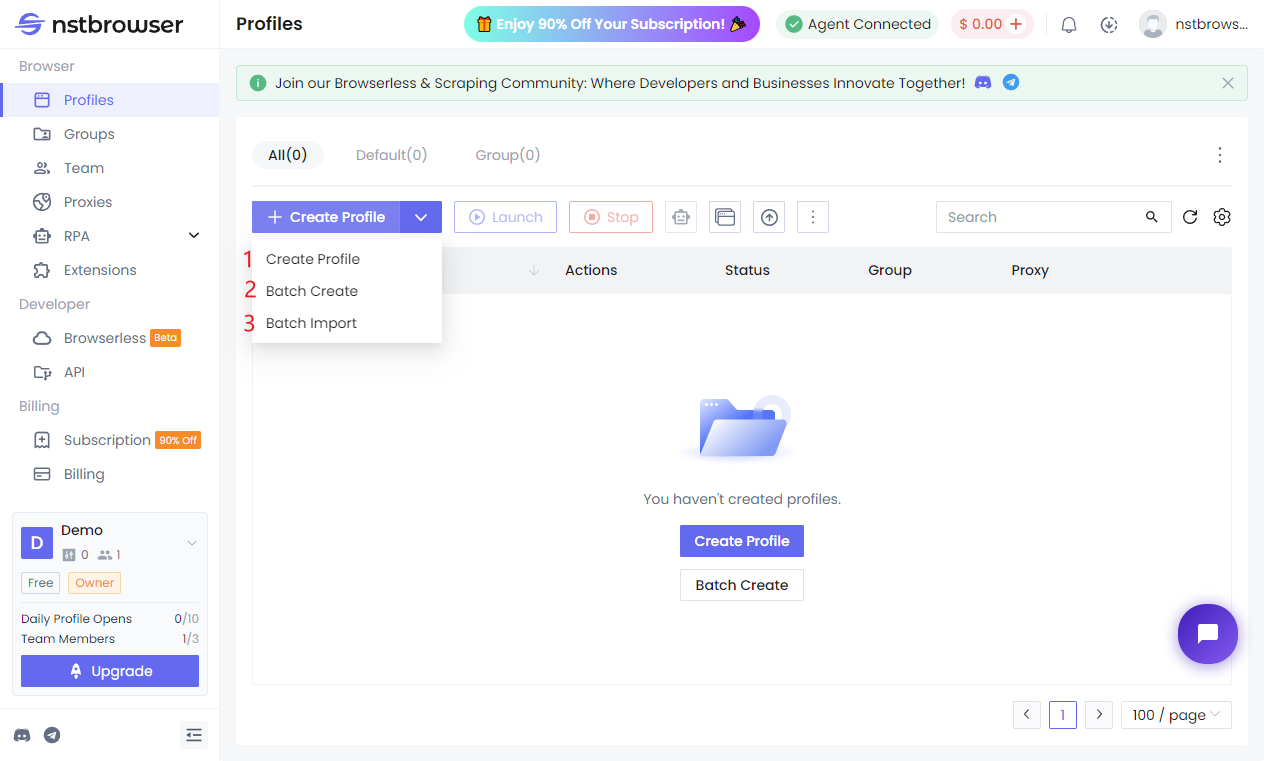
Create a separate Profile in Nstbrowser.
Bind the proxy to that Profile.
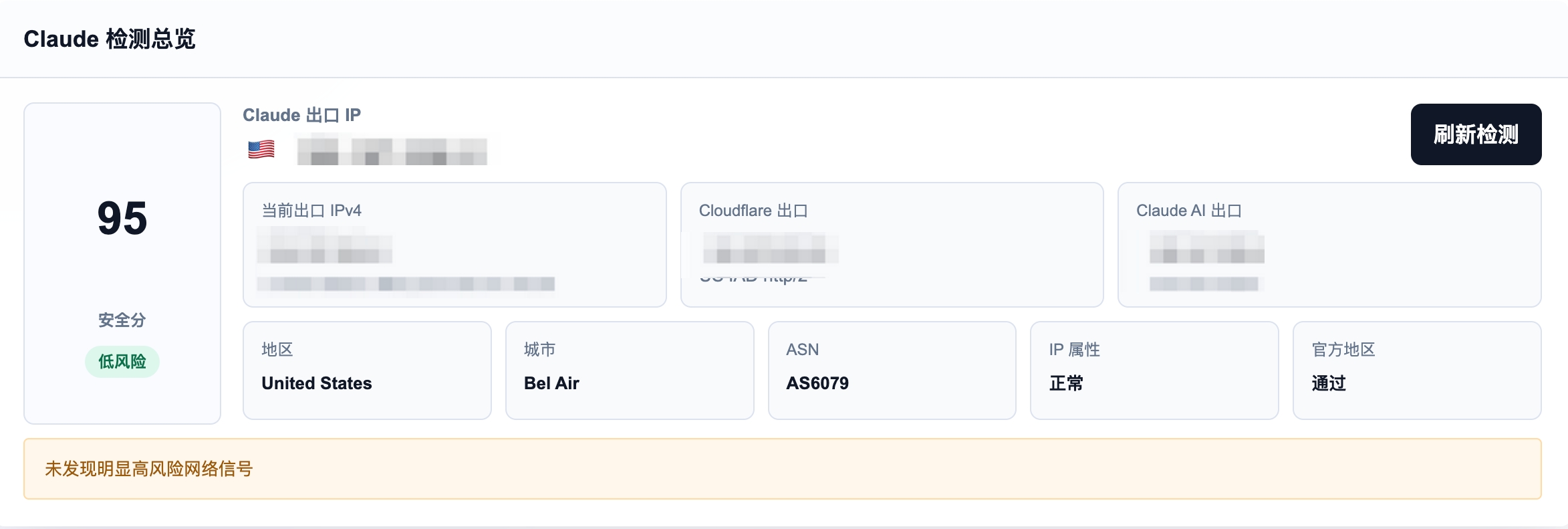
Check IP, timezone, language, DNS, and WebRTC.
Log in only after confirming that the environment is consistent.
Keep using the same IP and the same browser environment over time.
5. How to Configure a Stable Account Environment
If your goal is long-term stable use of Claude or other international platforms, follow the steps below.
Step 1. Define Your Use Case
First, decide whether you need a fixed identity or large-scale rotation.
If you only need temporary webpage access, choose a data center proxy.
If you need to collect public data at scale, choose a rotating residential proxy.
If you need long-term account login, dashboard management, or AI tool access, choose a Static ISP proxy.
Step 2. Choose a Consistent Proxy Region
When choosing a proxy region, do not only look at the cheapest or fastest node. Focus on whether the location matches your actual use case.
For example, if your account mainly serves the US market, choose a stable US proxy. If your business mainly targets the UK, Germany, Japan, or another region, choose an exit IP from the corresponding region whenever possible.
Avoid frequently switching proxies across countries or cities. For long-term accounts, regional consistency is more important than short-term speed.
Step 3. Test the IP and Environment
After enabling the proxy, do not log in to an important account immediately. Start with a basic environment check:
Confirm that the IP country and city are correct.
Check whether the proxy connection is stable.
Make sure the timezone, language, and IP region are consistent.
Check DNS and WebRTC for obvious conflicts.
Test whether the target website opens reliably.
If the IP region, browser timezone, system language, or access environment clearly conflicts, adjust the environment before logging in.
Create a separate Nstbrowser Profile for each platform.
For example:
One Profile for Claude
One Profile for ChatGPT
One Profile for Facebook
Do not mix multiple important accounts in the same browser environment. Each platform should ideally have its own proxy, cookies, cache, and environment settings.
Step 5. Bind the Static ISP Proxy
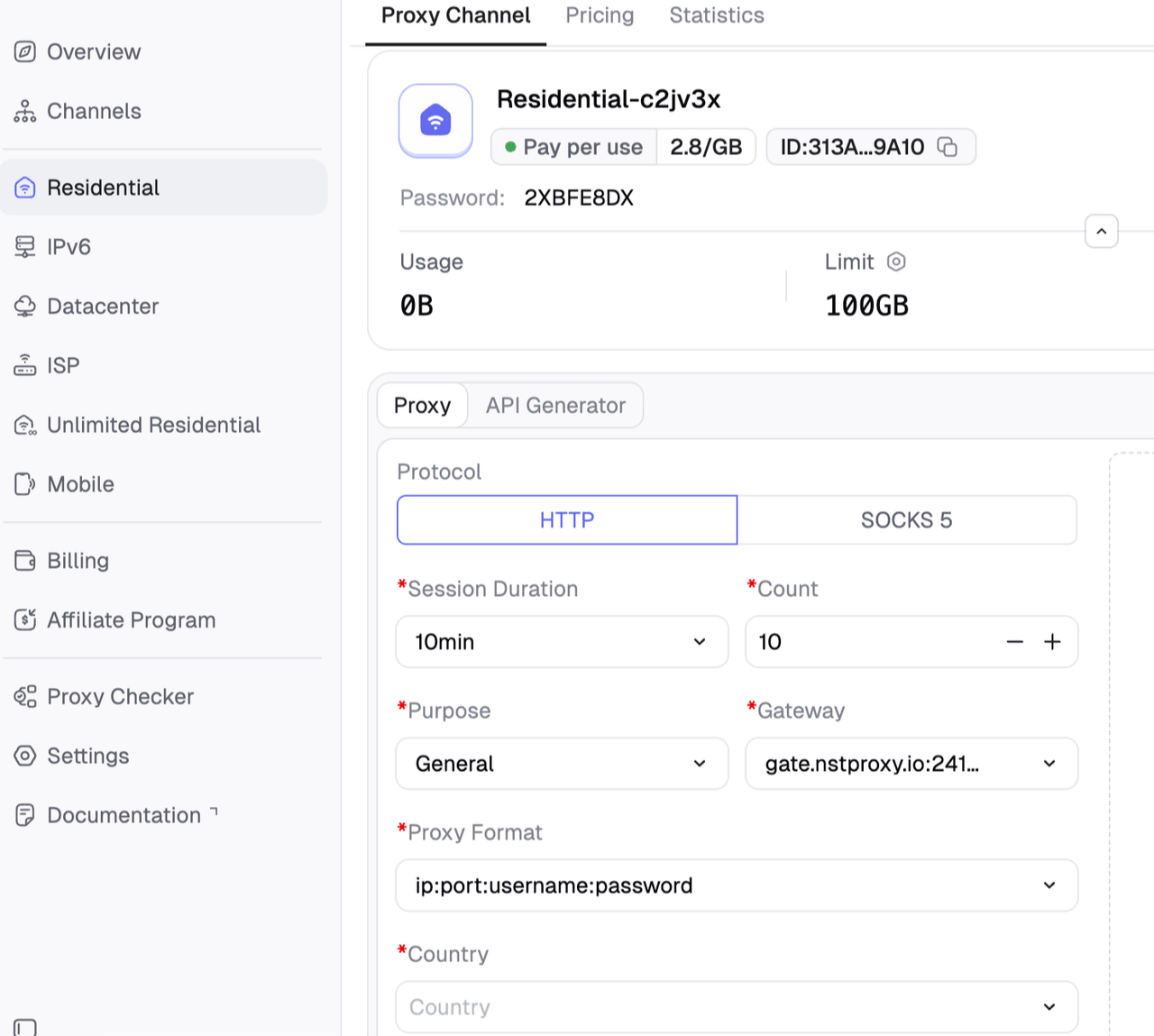
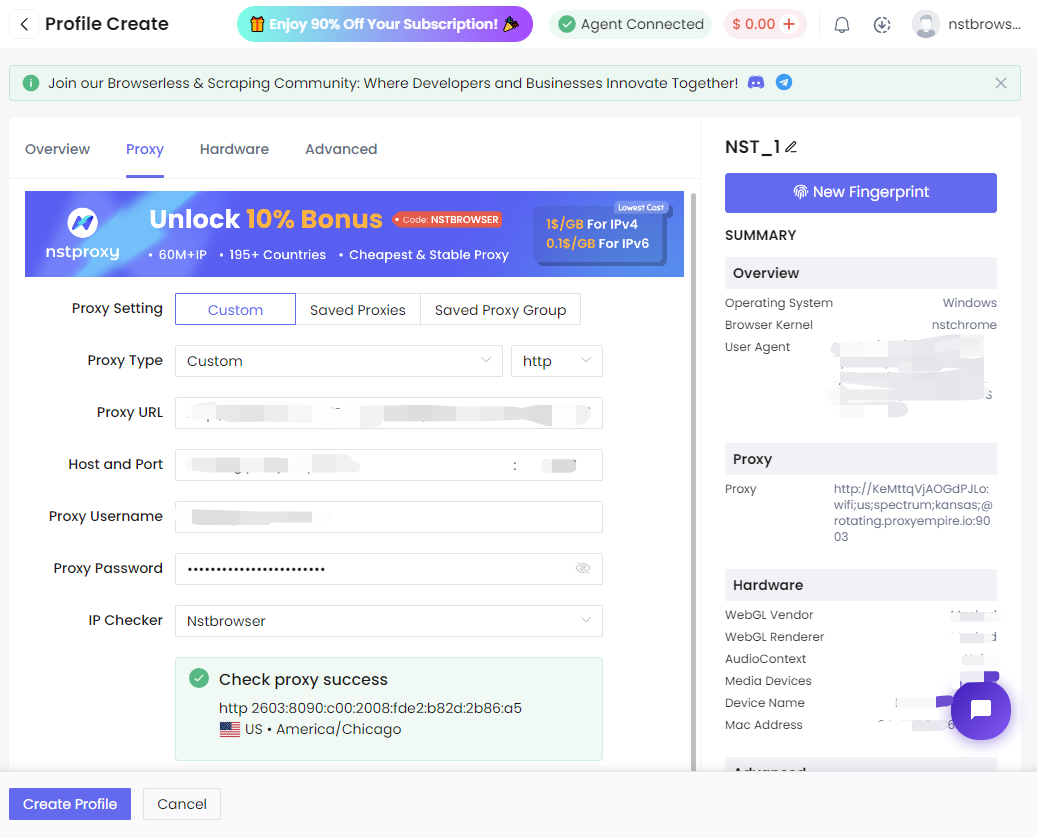
In the Nstbrowser proxy settings, enter the host, port, username, and password provided by Nstproxy.
After binding the proxy, test the connection first. Once everything is confirmed, open the target platform.
For long-term account use, keep the same ISP IP whenever possible. Avoid using one node today, another country tomorrow, and a different proxy pool the day after.
Step 6. Keep the Environment Stable After Login
After the account logs in successfully, avoid frequently changing proxies, browsers, devices, or regions. The key to long-term stability is not that nothing can ever change, but that the account should not show sudden abnormal changes.
Recommended practices:
Use the same Profile for the same account over the long term.
Bind the same Static ISP IP to the same Profile over the long term.
Avoid frequent country or city switching.
Avoid excessive logins, logouts, or verification attempts in a short period of time.
Avoid logging in to the same account from multiple regions at the same time.
For long-term accounts, stability is often more important than speed.
Step 7. Troubleshoot the Environment First if Problems Occur
If a platform asks for verification, shows login abnormalities, or restricts access, do not immediately refresh repeatedly, switch IPs, or log in again from a new device.
Instead, troubleshoot in this order:
Check whether the proxy disconnected or the region changed.
Check whether the IP is considered high-risk.
Check whether the browser Profile was mixed with other accounts.
Check whether timezone, language, DNS, or WebRTC settings conflict.
Check whether there were too many login or verification actions in a short period.
If the current IP is confirmed to be unstable, consider switching to a new Static ISP proxy and rebuilding a clean, stable browser environment.
6. FAQ
FAQ 1: Do I Need an ISP Proxy to Sign Up for Claude?
Not necessarily.
If Claude is available in your region and you can normally open, sign up for, and use Claude in a regular browser, you may not need a proxy.
But if you need long-term stable access to Claude, or if you often encounter unstable network conditions, account verification prompts, or changing access environments, a Static ISP proxy is usually more suitable than a rotating residential proxy or a data center proxy.
FAQ 2: Why Are Rotating Residential Proxies Not Recommended for Long-Term Account Logins?
Rotating residential proxies are valuable because they offer large IP pools, wide regional coverage, and flexible rotation. They are ideal for data collection, ad verification, SEO monitoring, and similar tasks.
But long-term account logins require a stable identity. A rotating residential proxy may frequently switch IPs, cities, or even countries, creating an abnormal login pattern from the platform's perspective. For account-based platforms such as Claude, social media, ecommerce dashboards, and ad accounts, frequent network changes can make verification or risk controls more likely.
FAQ 3: Can Data Center Proxies Be Used to Sign Up for or Log In to International Platforms?
They can be used for some low-risk, temporary access or testing scenarios, but they are not ideal for long-term account use.
Data center proxies usually come from cloud servers, IDC facilities, or VPS providers. They are fast and affordable, but their IP attributes are easy to recognize. Many platforms can use ASN data to determine whether an IP comes from a cloud provider or hosting network. For long-term account logins, data center proxies usually provide less trust and stability than ISP proxies.
FAQ 4: What Does an Nstbrowser Profile Do?
An Nstbrowser Profile provides an isolated browser environment for each account or platform.
It can separate cookies, cache, login status, browser fingerprints, language, timezone, and other environment data. When paired with Nstproxy Static ISP Proxy, it helps keep the network environment and browser environment more consistent over the long term.
In simple terms, Nstproxy solves the IP problem. Nstbrowser solves the browser environment problem.
FAQ 5: What Should I Do if I Cannot Receive a Claude SMS Verification Code?
First, check whether the country code and phone number format are correct. Also confirm that the phone number is from a region supported by Claude and can receive SMS messages normally.
If you still do not receive a code after waiting a few minutes, try again later or follow Claude Help Center guidance and use another phone number. Avoid requesting too many verification codes in a short period, as this may increase the chance of verification failure.
7. Conclusion: For Long-Term Stability on International Platforms, Choose ISP Proxies First
Data center proxies are suitable for short-term, high-volume, low-cost requests. Rotating residential proxies are better for data collection, ad verification, and multi-region access. ISP residential proxies are the better choice for long-term logins, account stability, and fixed identity scenarios.
If your goal is temporary access, a data center proxy may be enough. If your goal is bulk data collection, rotating residential proxies are more suitable. But if your goal is long-term stable use of international platforms while reducing the risk of account abnormalities, an ISP proxy is the stronger choice.
Nstproxy ISP proxies provide real ISP exits and fixed IPs. When paired with Nstbrowser Profile, they can further support browser environment isolation and long-term consistency. If you are dealing with unstable international platform accounts, frequent IP changes, or proxy detection issues, you can try Nstproxy ISP proxies to build a more stable network environment for your accounts.