How to Avoid IP Association in Multi-Account Management: Share Accounts With Lowest Risks
TL;DR
The biggest network risks in multi-account operations are multiple accounts sharing the same IP, using polluted shared proxies, or frequently switching IPs across different regions. These patterns can cause platforms to associate accounts with each other. A safer approach is to assign each account or account group an independent Nstproxy ISP node and create a separate Profile in Nstbrowser. This gives each account a fixed IP, a stable region, and an isolated browser environment, helping reduce the risk of bulk account reviews or restrictions.
In multi-account operations, the most damaging problem is often not one account being restricted. It is multiple accounts being identified as related accounts and then facing bulk restrictions, bulk verification, or bulk bans.
Many teams focus on account information, posting frequency, and device fingerprints, but overlook the most basic layer: the network environment. To platforms, IP address, login region, network type, and IP stability are all important signals for evaluating whether an account looks abnormal.
If multiple accounts use the same IP for a long time, or frequently switch between proxies in different regions, platforms may easily group those accounts into the same associated cluster. To reduce this risk, the core principle is simple: every account should have a stable, independent, and region-consistent network identity.
1. Core Network Risks in Multi-Account Operations
The most common network risks in multi-account operations fall into three categories.
1. Multiple Accounts Using the Same IP
If several accounts log in from the same IP over a long period, the platform can easily infer that the accounts are connected. This is especially sensitive on social media platforms, ecommerce platforms, ad accounts, AI tools, and SaaS dashboards. When several accounts use the same IP, one account issue may also affect the others.
2. Using Shared Proxies
The problem with shared proxies is that you do not know who used the IP before you, or whether it has already been used for spam registrations, bulk logins, scraping requests, or policy-violating activity. Even if your own operation is normal, a polluted IP may already carry elevated risk.
If an account logs in from the United States today, Germany tomorrow, and Singapore the day after, that pattern looks unnatural to platforms. Even when the IPs are real residential IPs, frequent changes and inconsistent regions can still be treated as abnormal login behavior.
The first step in reducing multi-account association risk is not blindly switching to more IPs. It is giving each account a stable, independent, and sustainable network environment.
2. Three Network Configuration Principles for Avoiding IP Association
To reduce IP association risk, follow these three principles.
Principle 1: Bind Each Account or Account Group to an Independent Fixed IP
If you operate an independent account matrix, each account should ideally have its own fixed IP. This gives every account its own network identity and makes it less likely that accounts will be connected simply because they share the same exit IP.
If you operate account groups under the same business, you can also assign fixed IPs by account group. For example, one region, one store, or one project team can use one dedicated network environment. The key is to avoid letting a large number of unrelated accounts share the same exit IP.
Principle 2: Prioritize Residential IPs With ISP Attributes
Ordinary data center proxies are affordable and fast, but their hosting attributes are usually obvious. Many platforms can identify whether an IP comes from a cloud server or IDC facility by checking ASN data, IP type, and network ownership.
By comparison, ISP residential proxies are more suitable for long-term account logins. They have real ISP network attributes while keeping a fixed IP. To platforms, this access pattern looks closer to a normal user's fixed network environment than a temporary exit from a proxy pool.
Principle 3: Keep the IP Region Consistent With the Account Region
The account registration region, login region, browser timezone, and language environment should stay consistent whenever possible.
For example, a US account should ideally use a US ISP node with matching timezone and language settings. Avoid having account registration information point to one region while the login IP consistently comes from another.
Stability, consistency, and long-term regional alignment matter more than chasing short-term low cost or high speed.
3. Why Choose Nstproxy ISP Proxies?
Nstproxy ISP proxies fit multi-account operation scenarios because they provide a more stable network identity.
For long-term management of multiple accounts, network stability is often more important than frequent IP replacement. Nstproxy ISP proxies combine the credibility of residential IPs with the stability of high-performance network infrastructure. This makes them suitable for social media operations, cross-border ecommerce, AI tools, ad operations, and other scenarios that require long-term account maintenance.
1. Real ISP IPs for a More Trustworthy Account Environment
Nstproxy ISP proxies use IPs assigned by real internet service providers rather than ordinary data center IPs. Compared with traditional data center proxies, they better match how platforms evaluate normal user network environments and help build a more stable, trusted network identity for accounts.
2. Fixed IPs for a Consistent Long-Term Login Environment
Each ISP Proxy is a statically assigned IP that can be used over the long term. When the same account always logs in from the same IP, it helps reduce abnormal login alerts, device verification, and other issues caused by frequent IP changes. This is closer to how real users behave.
3. Better for Account Registration, Warm-Up, and Long-Term Operation
Whether you operate social media accounts, cross-border ecommerce stores, Claude or ChatGPT accounts, or ad accounts, ISP proxies can provide a stable network environment for registration, daily login, account warm-up, and long-term operation.
4. Pair With Nstbrowser for Full Environment Isolation
When Nstproxy ISP proxies are used together with Nstbrowser Profiles, each account can have its own browser fingerprint, cookies, local cache, and fixed IP. This creates a complete isolated environment, helps prevent accounts from interfering with one another, and improves multi-account management safety.
5. Flexible Team Deployment and Easier Account Scaling
Whether an individual manages dozens of accounts or a company manages hundreds, ISP nodes can be configured flexibly based on account volume. Teams can use a one account, one IP, one Profile model to allocate and maintain account resources more easily.
6. High-Speed Stability for Long-Term Online Use
ISP proxies run on high-performance network infrastructure. While preserving IP authenticity, they can also provide lower latency and more stable connection quality, meeting the needs of long online sessions, automation, and continuous work.
In short, Nstproxy ISP proxies offer:
Real ISP exits, not simply disguised data center IPs
Fixed allocation for long-term use of the same IP
Strong fit for account login, account warm-up, and long-term operation
Compatibility with Nstbrowser Profile for complete environment isolation
Flexible node allocation based on team account volume
For multi-account operations, one clean, fixed, long-lasting ISP IP can often be more valuable than a large pool of dynamically rotating IPs.
4. Practical Nstproxy Setup for Multi-Account Operations
If you use Nstproxy and Nstbrowser for multi-account operations, follow this configuration process.
Step 1: Plan ISP Nodes Based on Account Volume
First, confirm how many accounts you need to operate and whether those accounts need to be fully independent.
If each account needs to be operated independently, assign each account its own Nstproxy ISP node. This gives every account a fixed exit IP and prevents network-level mixing between accounts.
If you operate account groups, you can allocate ISP nodes by group. For example, one business region can correspond to one account group, or one project can use one account group.
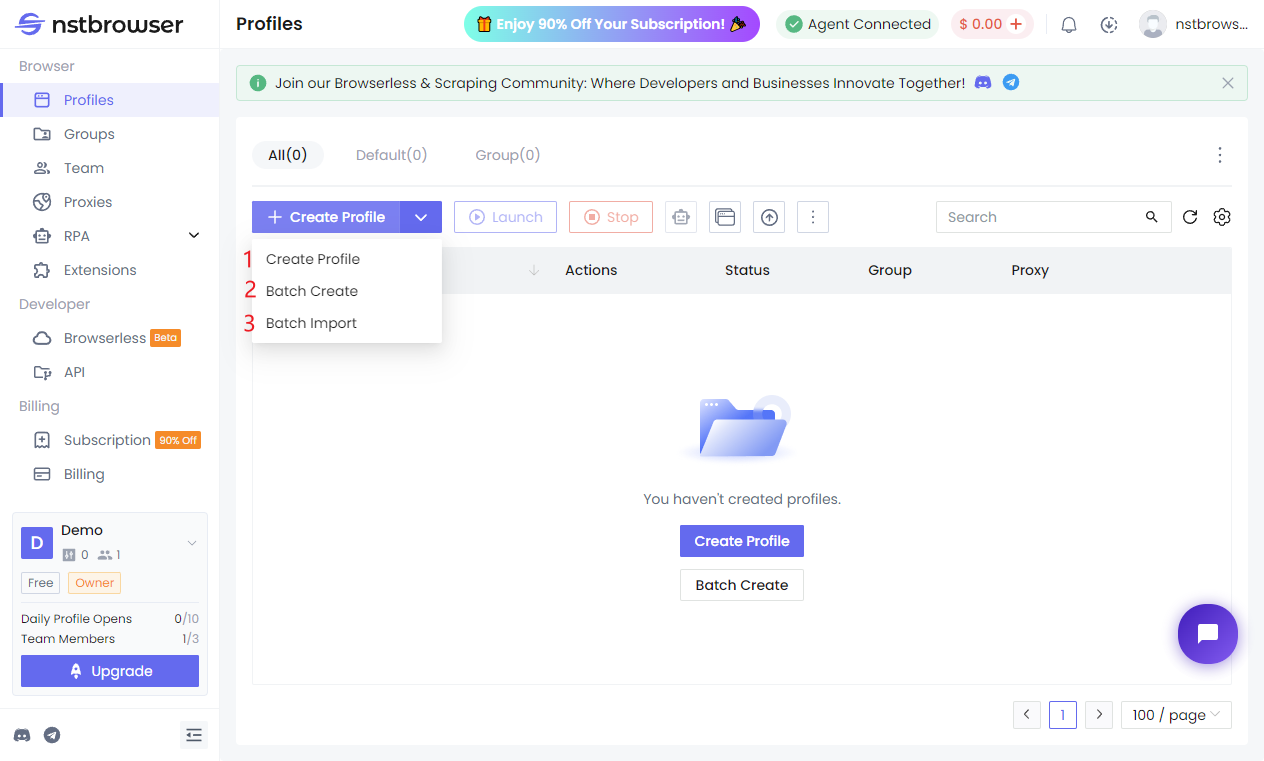
Step 2: Create an Independent Profile in Nstbrowser
Open Nstbrowser and create a separate Profile for each account.
Use clear names, such as:
US-Shop-01
US-Shop-02
TikTok-Account-01
Each Profile should only log in to its corresponding account and should not be mixed with other platforms or accounts. This keeps cookies, cache, login status, browser fingerprints, language, timezone, and other environment signals isolated.
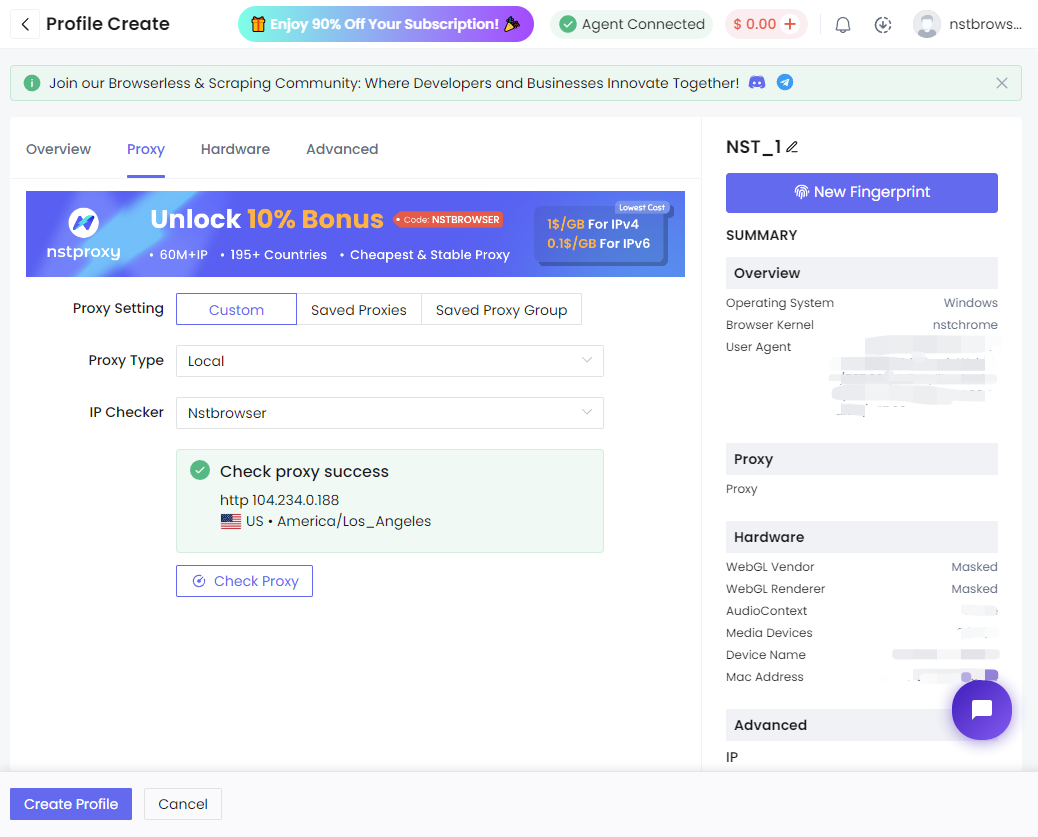
Step 3: Bind the Correct ISP Proxy to Each Profile
In the Nstbrowser proxy settings, enter the host, port, username, and password provided by Nstproxy for the corresponding Profile.
After binding the proxy, test the connection before opening the target platform and logging in.
The configuration logic is simple:
One account = one Nstbrowser Profile = one fixed ISP proxy.
This gives every account its own browser environment and independent network exit, reducing cross-account association.
Step 4: Keep the Environment Stable After Login
After an account logs in successfully, avoid frequently changing IPs, regions, Profiles, or device environments.
Keep these settings consistent over the long term:
The same account uses the same Profile
The same Profile is bound to the same ISP node
The IP region matches the account region
Avoid frequent logins and logouts in a short period
Avoid logging in to the same account from multiple regions at the same time
The goal of multi-account risk prevention is not to keep changing IPs. It is to maintain a stable environment without unnecessary jumps.
5. Cost Optimization Suggestions
If your team shares one account and you are not operating a multi-account matrix, you do not necessarily need multiple ISP nodes.
In that case, one ISP node plus one shared Nstbrowser Profile is usually enough. Team members access the same account through the same stable environment, which can reduce abnormal risk caused by region and device changes.
But if you operate a multi-account matrix, it is not recommended to let multiple accounts share the same ISP node. A safer approach is to purchase nodes based on account volume, or at least assign independent nodes by account group.
Simple decision guide:
Single shared team account: 1 ISP node + 1 shared Profile
Multi-account matrix: dedicated ISP nodes based on account volume
Region-based account operation: ISP nodes assigned by region
High-value accounts: prioritize one account, one node
Costs can be optimized, but the network environment of high-value accounts should not be the place to cut corners.
6. FAQ
1. Can Multiple Accounts Share One IP?
It is not recommended. If multiple accounts use the same IP for a long time, platforms may identify them as associated accounts. The risk is higher when there are many accounts, when the accounts are unrelated, or when their behavior patterns are similar.
2. Are Rotating Residential Proxies Suitable for Multi-Account Login?
Rotating residential proxies are more suitable for data collection, ad verification, SEO monitoring, and other scenarios that need large-scale IP rotation. Long-term multi-account login requires a more stable identity, so Static ISP proxies are usually more suitable.
3. Why Are Shared Proxies Riskier?
Shared proxies may have been used by many users, and the IP history is hard to control. If the IP was previously used for policy violations, spam registrations, or high-frequency requests, your account may be affected as well.
4. Does a Team Sharing One Account Need Multiple ISP Nodes?
No. If a team only shares one account, one ISP node plus one shared Profile is usually enough. The key is to keep the login region and browser environment stable.
5. How Should a Multi-Account Matrix Buy Nodes?
If each account is important, the recommended setup is one account per ISP node. If there are many accounts, nodes can also be assigned by account group, region, or business line. However, avoid letting a large number of accounts share the same IP.
7. Conclusion
To reduce account restrictions and association risk in multi-account operations, the network layer should be stable, independent, and consistent.
Do not let multiple accounts share the same IP. Do not use shared proxies with uncontrollable history. Do not let accounts jump frequently between different regions.
A safer solution is to assign each account or account group an independent Nstproxy ISP node and create a separate Profile in Nstbrowser. This gives each account an independent fixed IP, an isolated browser environment, and a consistent long-term login path.
If you are running a multi-account matrix, you can review Nstproxy bulk purchase options or contact the business team for ISP node configuration recommendations that better match your team size.